In his blog A Different Point of View retired journalist and activist Nick Fillmore shares his thoughts on why he thinks the feds should step in to help democracy’s watchdogs.
http://www.nickfillmore.blogspot.ca/

In his blog A Different Point of View retired journalist and activist Nick Fillmore shares his thoughts on why he thinks the feds should step in to help democracy’s watchdogs.
http://www.nickfillmore.blogspot.ca/
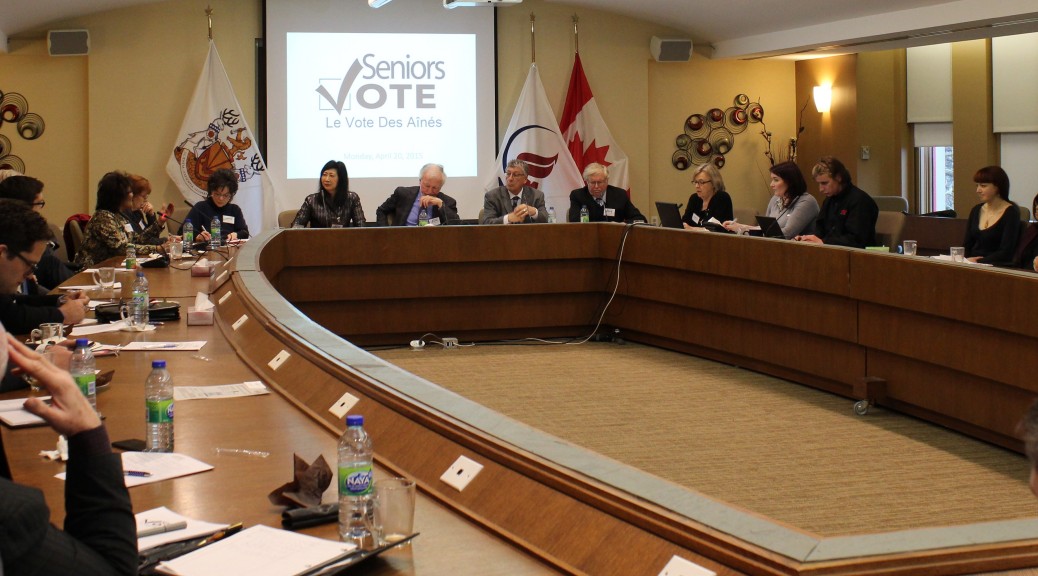
Seniors Vote/ Le Vote des Aînés, a nation-wide initiative comprised of more than fifty seniors, retirees, professionals and advocacy groups, representing more than a million seniors, was formed to promote the interest of older Canadians ahead of the upcoming federal election.
In late April, just before the federal budget was brought down, Seniors Vote/ Le Vote des Aînés representatives met with politicians in Ottawa (above picture) to advocate on behalf of seniors.
It is common knowledge that older Canadians are the most committed voters; 65% or more of older voters turnout to vote regularly. Older Canadians are also among the most politically engaged voters whose past party loyalty cannot be taken for granted. This has led all political parties to ask: “What do seniors want?
And the answer has been the call for the kind of transformative change in our public systems that will make life better for all Canadians as they age. Many such reforms will only benefit future generations.
Now for the details on Seniors Vote/ Le Vote des Aînés priority issues for the 2015 federal election. Continue reading CWA Canada Retirees Council Endorses Seniors Vote

As the New Year was approaching, a Nanos Research opinion survey indicated that Stephen Harper was regaining support due to perceived foreign policy successes and tax cuts.
But if the poll respondents were compelled to read this devastating review of Harper’s legacy, assessments of his leadership would surely plummet.

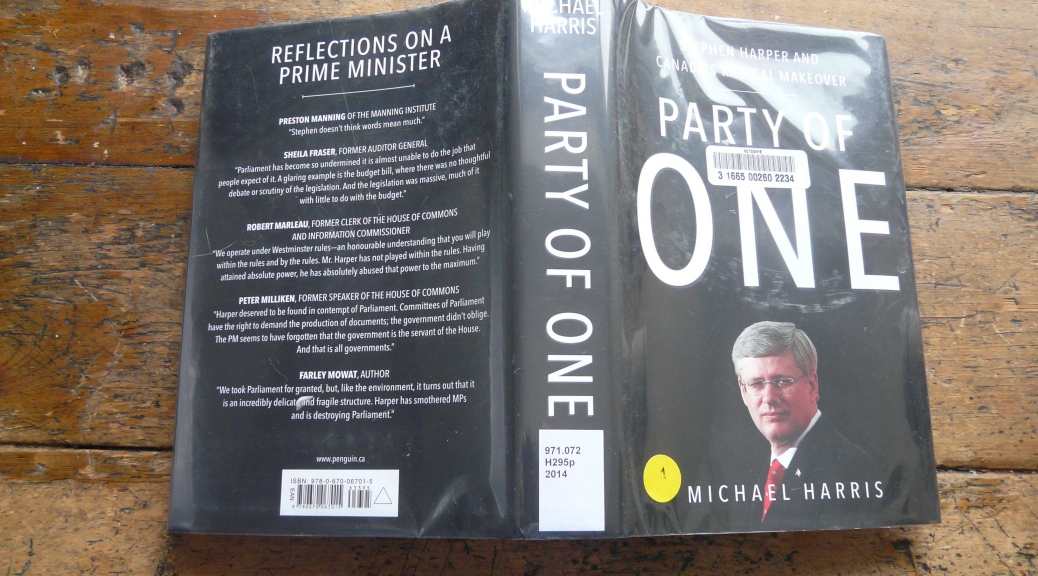
Journalist Michael Harris first describes Harper’s political evolution, from Reform Party stalwart and MP, to head of the anti-government, anti-union, pro big-business National Citizens Coalition, to his takeover of the Conservative Party of Canada – the October, 2003 merger between the Progressive Conservatives and Canadia Alliance. Basking in the glow of no-nonsense, business like stewardship of the ship of state, and for many Jews as Israel’s best friend among foreign leaders, two seminal scandals of his rule have revealed another, seamier side to his administration.
The robocalls affair in Guelph, Ontario and attempts to cover up the shenanigans of Senator Mike Duffy are described in breathtaking detail, as well as Harper’s other shortcomings. They indicate that under Harper’s reign, abuses have been committed that make the Liberal Sponsorship Scandal, which contributed to the party’s demise under Paul Martin, pale in comparison.
The book is briskly written and exhaustively researched. On the robocalls scandal, the only person convicted, Michael Sona, asked the writer rhetorically how a “22-year-old guy managed to coordinate this entire massive scheme when he didn’t even have access to the data?”
Potentially more withering is Harris’s elaborate dissection of the in’s and out’s of Duffygate – the various efforts by operatives in the Prime Minister’s Office, including disgraced chief of staff Nigel Wright, to deal with what began as “Old Duff’s” money issues.
After investigation, it quickly ballooned, with questions on claims for per diems and travel expenses when Duffy was the Conservative’s star bagman, crisscrossing the country on fund-raising expeditions.
Senator Irving Gerstein, the party’s chief bagman in charge of the Conservative Fund, first agreed to pay off Duffy’s $32,000 in debt to the Senate if he agreed to not talk to the media, then balked when the amount became $90,000. Was it a matter of principle or the amount?
Then came the now-famous emails from Wright to Harper’s personal lawyer in the PMO, Benjamin Perrin, when Wright says: “We are good to go from the PM…”
On March 23, 2014, the day after Wright paid off Duffy’s $90,000 debt, Perrin left his job in the PMO. Harper says he had no knowledge of this transaction, but as Harris demonstrates in this intricate account of the scandal, questions remain.
Wright returned to work for Onex Corp. where he recently masterminded two massive deals totaling more than $5 billion from his base in London.
Duffy was charged with 31 counts related to fraud, bribery, and breach of trust, prompting Duffy’s lawyer, Donald Bayne, to ask: “How what was not a crime or bribe when Nigel Wright paid it on his own initiative, became however mysteriously a crime or bribe when received by Senator Duffy.”
Duffy is scheduled to appear in court April 7 and the trial is expected to last 41 days. Will promised disclosures erode Harper’s standing in the polls?
After enduring countless painful stomach cramps while doing long and hard thinking, I will do here what I’ve never done during a 40-year-long career in journalism. I will speak in the first person

to publicly discuss the situation at Radio-Canada/CBC. I have spent 37 years at Radio-Canada as a local journalist, parliamentary and international correspondent, columnist, and with Radio-Canada International, as Chief Editor.
As we know, our national public broadcaster is now in the eye of the storm, and will come out of it seriously disfigured and wounded to the core. Many things have been said in the last few months about the long series of budgetary cutbacks at Radio-Canada/CBC. It all began, let’s not forget in the 1980s under the Brian Mulroney government. But I will focus on three points : Public service, the shift to digital media, and what happens next. Continue reading CBC – Enough is enough, a first-person account
All the talk recently about Canadians being spied on by our own government agencies got me thinking about my days as a so-called spy when I eavesdropped on the Russians during the Cold War back in the 1960s. I was a Radioman Special with the Royal Canadian Navy with a top-level security clearance. With the integration of the Canadian Forces in 1996 the name was changed to Communicator Research Operator, the same name used today for military personnel with Communications Security Establishment Canada, which has been in the news a lot over the past year or so. Continue reading Keep your spies out of my computer
Continue reading I’ll march for the CBC … but not at any cost
I have been aware and concerned about democratic and social-justice values ever since I first voted, a very long time ago. It was in the 1966 Québec provincial election. I’ve been defining myself as a “social democrat” since my young-adult years, which saw me canvassing for a then new Québec political party where most progressive people could be found. Of course in 1976, when I became a broadcast journalist, I had to end my involvement in partisan politics. But throughout my 37 working years, 33 at Radio-Canada, I would dream about getting back into active politics once I retired. Well, the dream finally came true on Aug. 2, 2012, the day after I officially retired from CBC/Radio-Canada. That is when I first joined the New Democratic Party.
Continue reading Reflections of a retired journalist reborn as a social-democrat activist
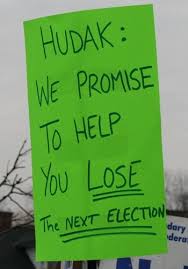
In his recent video, Made in the USA: Tim Hudak’s Plan to Cut Your Wages, retired journalist Bill Gillespie exposes the truth about the Ontario Conservative leader’s right-to-work crusade.
Even though Hudak is reported to have retreated from his crusade, workers are gearing up to take him on in the next provincial election.
Gillespie’s story was featured in a recent CWeh! Canada newsletter.

MONTREAL– For working people, Quebec’s April 7 provincial election focused sharply early in the campaign on the arrival of media mogul Pierre Karl Péladeau onto the active political scene as a Parti Québecois candidate.
Continue reading Media mogul grabs Quebec election spotlight
Have Tim Hudak’s Ontario Tories backed down from their attack on organized labour in Ontario? After not winning the by-election in Niagara Falls, the Ontario Tory leader told the Toronto Region Board of Trade that he and his party have no plans to implement their U.S. style right to work proposals. Does this mean they have seen the light and are finally listening to some of their own members who have expressed concern over the policy? No, says The Ontario Federation of Labour (OFL).