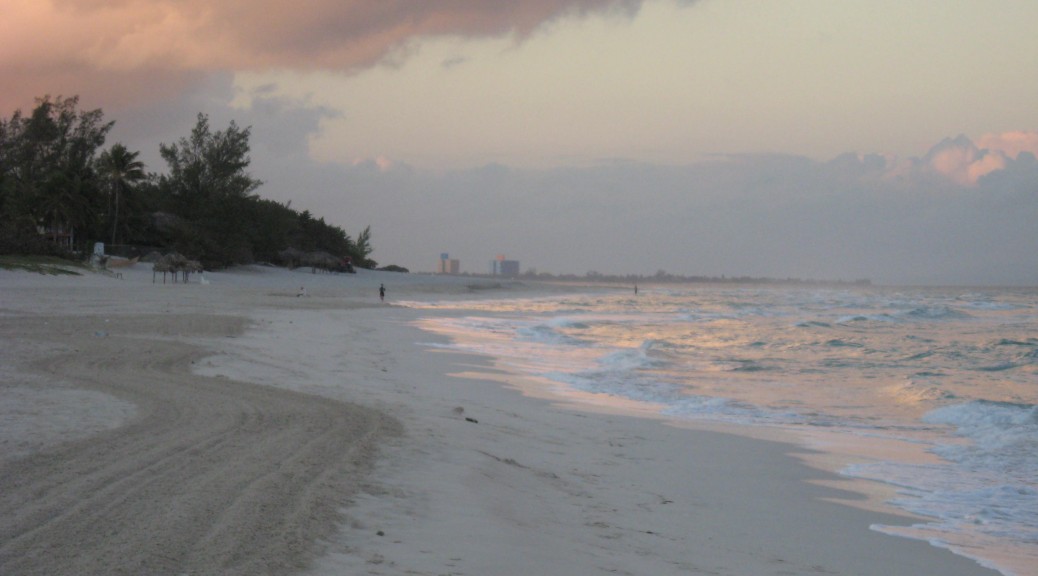
My love affair with Cuba won’t change sharing my favourite with Americans.
This article was first posted on my blog NewfieTraveller

My love affair with Cuba won’t change sharing my favourite with Americans.
This article was first posted on my blog NewfieTraveller


The allure of the open road isn’t what it once was, but for those of us who came of age before the world became so interconnected, the romance of driving for driving’s sake has never gotten old. As long as we’re on the go, we don’t much care where we’re headed.
I grew up before the Internet, smart phones and social media turned the world into a global village that even Marshall McLuhan couldn’t have envisioned. My generation read Jack Kerouac’s “On the Road” and John Steinbeck’s “Travels With Charley,” and digested movies like “Easy Rider” and TV shows like “route 66.”
Life is a highway, as singer-songwriter Tom Cochrane put it.
Naturally, I didn’t turn down an invitation from a fellow retired newspaper guy to be part of a two-man road trip across the U.S. this winter.
Over a game of pool, friend Mike Shenker put it this way, “We’ll be in search of an America that once was … or maybe never was.” How fitting, I thought, at age 66 I’m going to get my kicks on Route 66.”
Continue reading TRANSCONTINENTAL ROAD TRIP IS ABOUT THE GOING, NOT ABOUT THE GETTING THERE

What can we do to ensure a strong future for CBC?
The single most important thing any one of us can do is have a conversation about the value of public broadcasting. And then have another one, and another one after that.
Public broadcasting is about the kind of country we want to live in – it’s about the kinds of communities we want to build together. It’s about values and priorities. Continue reading Champion Public Broadcasting – Making the case for CBC / Radio-Canada

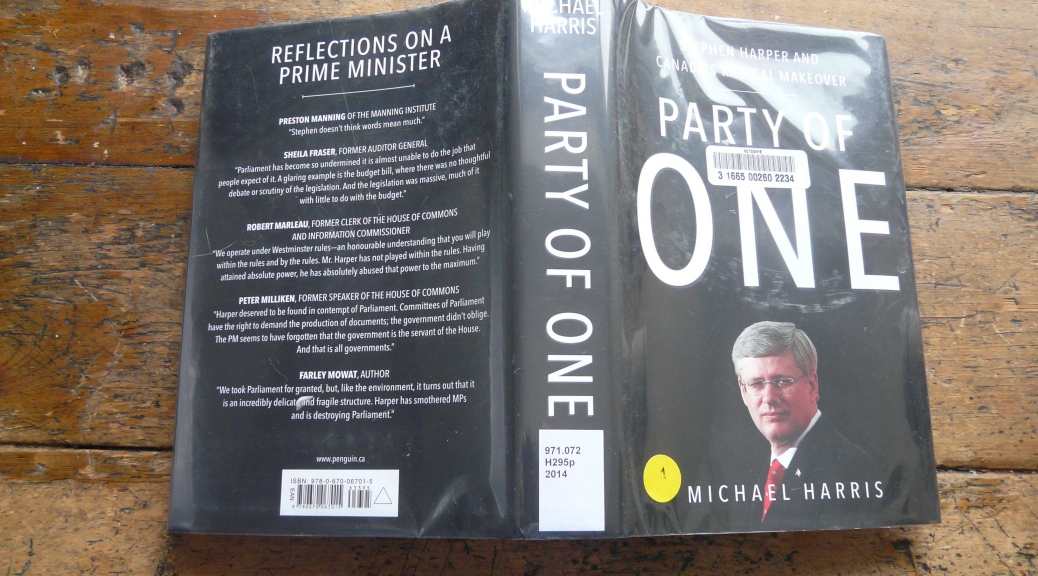
As the New Year was approaching, a Nanos Research opinion survey indicated that Stephen Harper was regaining support due to perceived foreign policy successes and tax cuts.
But if the poll respondents were compelled to read this devastating review of Harper’s legacy, assessments of his leadership would surely plummet.

Journalist Michael Harris first describes Harper’s political evolution, from Reform Party stalwart and MP, to head of the anti-government, anti-union, pro big-business National Citizens Coalition, to his takeover of the Conservative Party of Canada – the October, 2003 merger between the Progressive Conservatives and Canadia Alliance. Basking in the glow of no-nonsense, business like stewardship of the ship of state, and for many Jews as Israel’s best friend among foreign leaders, two seminal scandals of his rule have revealed another, seamier side to his administration.
The robocalls affair in Guelph, Ontario and attempts to cover up the shenanigans of Senator Mike Duffy are described in breathtaking detail, as well as Harper’s other shortcomings. They indicate that under Harper’s reign, abuses have been committed that make the Liberal Sponsorship Scandal, which contributed to the party’s demise under Paul Martin, pale in comparison.
The book is briskly written and exhaustively researched. On the robocalls scandal, the only person convicted, Michael Sona, asked the writer rhetorically how a “22-year-old guy managed to coordinate this entire massive scheme when he didn’t even have access to the data?”
Potentially more withering is Harris’s elaborate dissection of the in’s and out’s of Duffygate – the various efforts by operatives in the Prime Minister’s Office, including disgraced chief of staff Nigel Wright, to deal with what began as “Old Duff’s” money issues.
After investigation, it quickly ballooned, with questions on claims for per diems and travel expenses when Duffy was the Conservative’s star bagman, crisscrossing the country on fund-raising expeditions.
Senator Irving Gerstein, the party’s chief bagman in charge of the Conservative Fund, first agreed to pay off Duffy’s $32,000 in debt to the Senate if he agreed to not talk to the media, then balked when the amount became $90,000. Was it a matter of principle or the amount?
Then came the now-famous emails from Wright to Harper’s personal lawyer in the PMO, Benjamin Perrin, when Wright says: “We are good to go from the PM…”
On March 23, 2014, the day after Wright paid off Duffy’s $90,000 debt, Perrin left his job in the PMO. Harper says he had no knowledge of this transaction, but as Harris demonstrates in this intricate account of the scandal, questions remain.
Wright returned to work for Onex Corp. where he recently masterminded two massive deals totaling more than $5 billion from his base in London.
Duffy was charged with 31 counts related to fraud, bribery, and breach of trust, prompting Duffy’s lawyer, Donald Bayne, to ask: “How what was not a crime or bribe when Nigel Wright paid it on his own initiative, became however mysteriously a crime or bribe when received by Senator Duffy.”
Duffy is scheduled to appear in court April 7 and the trial is expected to last 41 days. Will promised disclosures erode Harper’s standing in the polls?

David Hawkins was a participant at a Weekend Pre-retirement Course in Toronto on Saturday, November 15, 2014. Here is his report.
By DAVID HAWKINS
We’re all going to die. And we’re going to pay taxes to the very end.
Those two certainties don’t disappear when we stop cursing the alarm clock.
We’re all going to die. And we’re going to pay taxes to the very end.
Those two certainties don’t disappear when we stop cursing the alarm clock.
The government’s slice of our pie may shrink some when fixed incomes kicks in. But every sunrise rolls everyone closer to the day we won’t mist the mirror anymore. Continue reading Retirement: Don’t despair. Prepare.
Sunday, November 16, 2014
CBC/Radio-Canada supporters gathered in Montreal, Matane, Sept-Îles, Quebec City, Saguenay, Sherbrooke, Trois-Rivières, Rimouski, Gaspé and Moncton in New Brunswick to protest against deep cuts and job losses at the Crown corporation.

A sea of blue flags emblazoned with the CBC logo – also known as the  CBC pizza – rolled down René-Lévesque Boulevard in Montreal Sunday afternoon.
The protests across Quebec and in Moncton were organized by CBC/Radio-Canada’s main unions for the French-language service, along with other supporters operating under the banner Tous Amis de Radio-Canada (Friends of CBC.)
Protesters assembled at Montreal’s Square-Victoria and headed to the CBC headquarters in Quebec, Maison Radio-Canada, where organizers decried the cuts to Canada’s public broadcaster.
Below are news stories written about the Montreal rally.
http://montrealgazette.com/news/local-news/thousands-march-to-protest-cbcradio-canada-cuts
http://www.huffingtonpost.ca/2014/11/16/radio-canada-job-cut-protest_n_6167546.html


Just wrapping up two weeks on P.E.I. where I’ve been pondering this philosophical question: Can retired people ever be said to be “on vacation”?
It’s been a relaxing sojourn at the North Rustico summer home of a couple of Montreal friends, much of it spent stretched out on Muskoka chairs on the deck, reading, and watching the herons patiently fishing and the little lobster boats chugging by.
Winnie and I make it a habit to vacation after Labour Day to avoid the heat, humidity, high-season prices and tourist hordes of summer. Continue reading Can a retiree take a vacation? Why not?
After enduring countless painful stomach cramps while doing long and hard thinking, I will do here what I’ve never done during a 40-year-long career in journalism. I will speak in the first person

to publicly discuss the situation at Radio-Canada/CBC. I have spent 37 years at Radio-Canada as a local journalist, parliamentary and international correspondent, columnist, and with Radio-Canada International, as Chief Editor.
As we know, our national public broadcaster is now in the eye of the storm, and will come out of it seriously disfigured and wounded to the core. Many things have been said in the last few months about the long series of budgetary cutbacks at Radio-Canada/CBC. It all began, let’s not forget in the 1980s under the Brian Mulroney government. But I will focus on three points : Public service, the shift to digital media, and what happens next. Continue reading CBC – Enough is enough, a first-person account
Matthew Radz has been easing into retirement since he quit working seven years ago after 40 years in the newspaper business. He was an editor and arts writer on half a dozen publications, including The Toronto  Telegram, the Montreal Star, Harrowsmith magazine and, since 1980, The Montreal Gazette. Post-retirement passions include nature/urban photography, long 19th-century novels, and he still dabbles in writing. He took time out from his busy retirement life to write this piece.
No visa or passport required, but there is the paperwork and the hundred and one details, to say nothing of the nagging questions. Will I have enough money to live on? – the most pressing and immediate.
By Terry LeDrew
My union was always there for me, from early days of NABET, to the CMG today. My one regret is having waited 25 years before I mustered the guts to run as VP locally, then for national director of small stations. My time in that position was the happiest and most fulfilling experience I’d had with CBC.
So last weekend (CWA Canada retirees founding meeting) was like coming home.